

 Ryan Swano
 Raising Mixed Kids
“I am mixed with all kinds of goodies.“
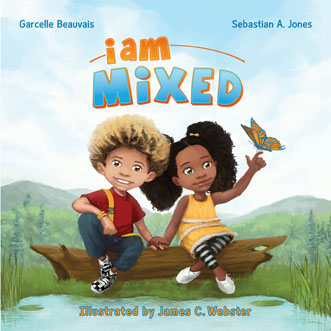
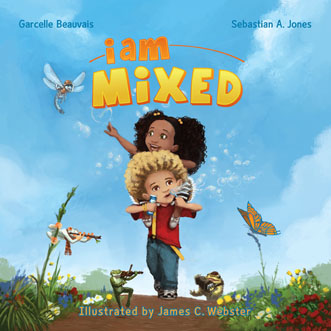
“Jay and Nia are the children of two worlds, and as they’ll discover, they can enjoy the best of both. From Mommy’s jazz beats to Daddy’s classical piano, we will dance with the twins through a book that explores what it is to be of mixed ancestry, proving that a child is more than the sum of their parents. “I Am Mixed is an invaluable teaching tool that all children from all races can learn from.” – Halle Berry (from her foreword)
This new book for children, and their parents, “I Am Mixed” by Sebastian A. Jones and Garcelle Beauvais, hasn’t even reached the shelves as a hard copy yet and already it is causing a sensation with Hollywood stars like Halle Berry singing its praises and the whole concept of the book stirring debate amongst those who have read it and those, like me, have but only read about it.
Haitian born co-author Beauvais is a well-known Hollywood actress with roles in series like “NYPD Blue” and “The Jamie Foxx Show” to her credit and that means that the 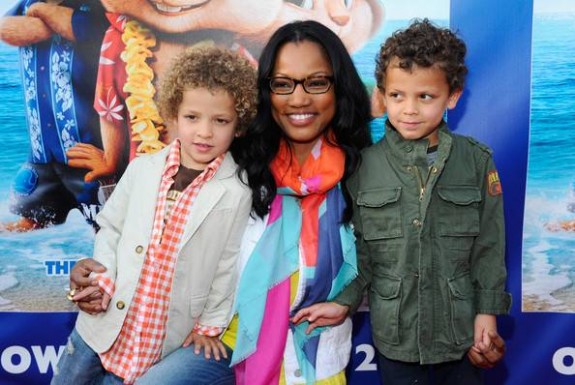 marketing machine is already well oiled.
By all accounts very in touch with her Creole heritage, (most Haitians, including Beauvais, have a small dilution of French ancestry but consider themselves Black and not mixed), her qualification to write this book is the fact that she is raising her own brood of racially and culturally mixed children fathered by her White ex-husband.

Jones, an author and publisher, himself being a veritable mix of peoples from across the world and having kids with a partner who in turn is a mix of Peruvian and Cuban, immediately latched onto Garcelle’s idea when the two of them met by pure chance while their kids were playing together in a park.
With more and more people in the US starting to make it clear that the ‘one drop rule’ doesn’t quite cut it for them and that identifying themselves as ‘mixed-race’ doesn’t diminish the fact that they can still identify with being Black or in the case of mixed Latinos, identify with being Hispanic without having a complete sense of separation from the other parts of their ancestral make-up. A leading example of this new mind-set would be the current US president Barrack Obama.
You might ask what, if anything, does this little kiddies book then have to do with us living here far away in a world where mixed-race people have been a reality since forever.
In South Africa, where through old Apartheid legislation for generations, being mixed-race placed you separate from other population groups and through laws like the Immorality Act, mixed-race people labelled as Coloured were only allowed to procreate amongst themselves.
With those same laws applying to Blacks, Whites and Indians, for about 40 to 50 years up until the late 1980’s, there were very few first generation mixed-race kids born. However since the fall of Apartheid legislation, we have a new dynamic in our population.
In South Africa a comparatively large number of first-generation racially and culturally mixed people have now reached adulthood and more and more of those first generation mixed-race people are being born every day, not only mixed between black and what but across the whole spectrum of different cultures and racial classifications found here.
 I would suggest that no matter where in the world they are, the questions in those kids’ minds are pretty much the same when they start realising that their two sets of extended families are ‘different’.
“Where and how do I fit in culturally?”
This question of course is not limited to them, but I have seen kids born to Coloured families with long lineages of being mixed but no longer residing in historically Coloured communities, grappling with their own cultural identity issues.
South African comedian Trevor Noah, himself a first generation mixed-race person uses his experiences growing up with these cultural identity questions in many of his routines and (in)famously summed it up with his ‘Undiluted Oros’ joke which in the grand scheme of things pretty much makes sense.
My interest in this little book was sparked because I’m always trying to expand my views on how I can help shape my kid’s way of looking at himself as a unique individual beyond the colour of his skin but still within the context of us still having to deal with the remnants of Apartheid. As a parent I sometimes am at pains to figure out how to answer his questions about race and cultural identity without imprinting anything negative and permanently damaging that brilliant little mind of his. It must be brilliant if he keeps asking me questions that I find difficult to answer.
On the one hand I’m trying to teach him that he should see himself and others as individuals who are not and should not be bound or judged on how they are categorised by past racial classifications while on the other hand…
I know I would do him a great disservice and give him a false sense of security if I did not teach him that for quite some time to come, at least for the near future, people will still be seeing him and treating him according to their prejudices.
Unfortunately for the foreseeable future, as he grows older, I should try to teach him that a whole group of people who are born into the same population group classification that he was born into will at times be maligned by the prejudices of others and that he is duty-bound to stand up for the rights of this group and never idly stand by as if he by choice is unaffected because he chooses not to label himself.
My hope is that even if he does not want to be identified as a Coloured… he should somehow be able to identify with Coloureds.
I’m sure each one of you has your own way of dealing with these issues but, whether you or your kids are first generation mixed-race or come from a long line of mixed-race people, if like me you want some help from what promises to be a fun and easy-to-read children’s book, then this is probably the one you should get. If not for the little life lessons, then at least to add more reading material to your child’s little library.
Fediverse Reactions
Post URL
Your Profile
Why do I need to enter my profile?
This site is part of the ⁂ open social web, a network of interconnected social platforms (like Mastodon, Pixelfed, Friendica, and others). Unlike centralized social media, your account lives on a platform of your choice, and you can interact with people across different platforms.
By entering your profile, we can send you to your account where you can complete this action.
