

 Henriette Abrahams
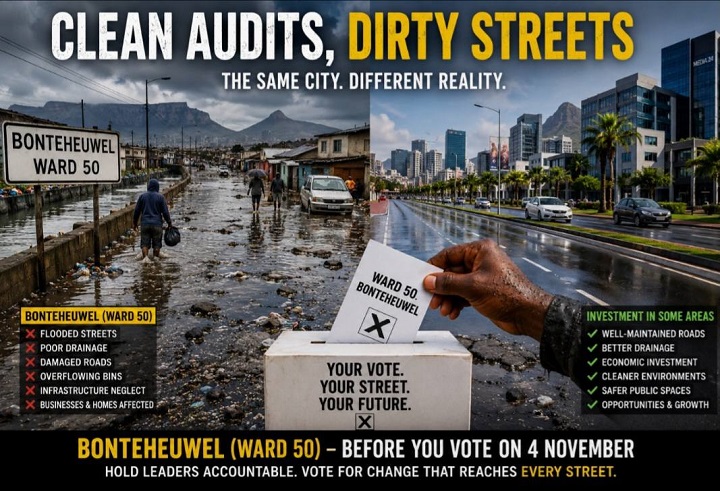
A ballot box moment with too many unanswered questions
As we move toward the ballot box on 4 November, we are once again surrounded by campaign slogans, promises of renewal, and political messaging that speaks of progress and good governance. Yet for many people living on the Cape Flats and in working-class communities, the question remains far more immediate and grounded in everyday experience. What has actually changed in our streets, our homes, and our daily lives?
While we are told that municipalities are well managed, supported by clean audits, strong financial systems, and internationally recognised governance standards, the lived reality in many neighbourhoods tells a different story. Winter turns our streets into swamps. Sewage flows through public spaces. Rubbish accumulates where services fail. Roads are filled with potholes and damaged surfaces that make daily movement difficult and costly. Housing waiting lists stretch across generations. Food insecurity is rising. Unemployment remains structural. Addiction, violence, and survival economies have become part of daily life for too many households.
This is the gap we must confront. How can a system be declared successful on paper while so many communities experience continued struggle in practice?
Clean audits and the gap between paper and lived reality
In the Western Cape, municipalities governed primarily by the Democratic Alliance, and operating within a broader national context shaped by the Government of National Unity, are often presented as examples of strong governance. Success is measured through clean audits, investment attraction, infrastructure expansion, and financial performance indicators. These are not irrelevant measures, but they do not tell the full story of lived experience.
A clean audit does not stop flooding in winter. It does not build a house for a family that has waited decades. It does not ensure that roads in working-class communities are maintained to the same standard as economic corridors and tourist routes. It does not put food on the table for households without stable income. And it does not guarantee safety in communities where violence, poverty, and exclusion are daily realities.
There is a growing gap between what is presented as success and what is experienced as survival.
Who is the city built for?
Cape Town is also a city of investment, tourism, and global branding. Significant resources are directed toward infrastructure that supports economic corridors, property development zones, tourism routes, and city image management. Safety strategies often prioritise key transport routes and commercial areas. At the same time, many working-class communities continue to experience flooding, housing shortages, inadequate public spaces, environmental neglect, and infrastructure that does not match local need.
This raises a fundamental question. Is the city being built equally for all its residents, or differently depending on where you live?
Safety, dignity, and the meaning of security
Safety is often presented through policing, surveillance, and enforcement. While these may be important tools, real safety is broader than control. Real safety is a home that does not flood, a street that is maintained, a child who can walk safely to school, and a community that has access to opportunity and dignity. Without these foundations, enforcement alone cannot produce safety.
Work, tenders, and survival economies
Work and economic participation also require honest reflection. Programmes such as EPWP are often described as job creation, yet for many people they function as short-term survival work in an economy where long-term employment remains out of reach. At the same time, essential services such as waste management, cleaning, and security are frequently outsourced through tender systems. This raises a deeper question about why public life is increasingly structured around contracts for a few instead of building stable public capacity and decent work for many.
Roads and the infrastructure of everyday life
Road infrastructure offers another visible example of this gap. Across many working-class communities, roads remain filled with potholes, cracks, and delayed maintenance. In winter, poor drainage compounds flooding and makes movement difficult and unsafe. In contrast, major economic and tourism routes often receive faster and more consistent maintenance. Infrastructure is therefore not experienced equally. It is often prioritised according to economic visibility rather than equal need.

Party lines, community voice, and accountability
One of the deeper issues in our system is that elected representatives often follow party lines more than they follow community mandates. Councillors are shaped by internal party structures and discipline rather than continuous accountability to the communities they serve. This weakens one of the core promises of local democracy, which is that people should be able to hold their representatives directly accountable for what happens in their streets and neighbourhoods. Instead, accountability often flows upward into party systems, while downward accountability to communities remains weak and inconsistent.
We cannot have situations where councillors such as in the instance of above inflation increased municipal vote along their party position and not in the interest of their constituents in impoverished communities.
At the same time, voters are frequently faced with a crowded ballot, with multiple parties contesting the same ward. This fragments community voices and raises an important question about how accountability is meant to function when representation is divided across so many competing political parties in their competition for a seat in council or proportional representation at the expense of our people.
Parties must be honest in calculating their chances in a ward and refrain from putting up candidates in wards they don’t even stand a chance to garner the third most votes. Instead, they should unite with the local community and endorse a community-endorsed and selected candidate.
Western Cape Elections 2026: Why Small Margins, Split Votes and Quiet Voters Are Deciding Everything
A call for community unity and local accountability
This is why communities must begin to seriously consider stronger forms of unity around community-selected candidates who are chosen through local processes, endorsed by residents, and held directly accountable to those communities between elections. This does not weaken democracy. It strengthens it at the level where it matters most, which is the neighbourhood and the ward.
The constitutional standard we already have
We also do not need to guess what local government is supposed to do. The Constitution already provides a clear standard. Sections 152 and 153 require municipalities to provide services, promote social and economic development, create safe and healthy environments, and prioritise the basic needs of communities in planning and budgeting. These are not optional aspirations. They are binding responsibilities.
As we approach the election, every candidate and every party should be asked what their plan is for basic services, housing delivery, job creation, economic opportunity, and measurable accountability. Not in speeches, but in outcomes.
Read more about Local Government Elections
Keeping our eyes on the ballot and on our streets
Ultimately, this election is not only about political branding or party competition. It is about whether our vote translates into dignity, functioning services, real housing delivery, safe communities, and economic opportunity that reaches ordinary households.
For too long, systems have been judged successful on paper, (by attaining clean audits), while communities carry the burden in reality. That must change.
Because democracy is not only the right to vote. It is the right to see that vote reflected in daily life.
And that means voting with clarity, unity of purpose, and a demand for accountability that is rooted in where we live.
Henriette Abrahams is a Community Activist based in Bonteheuwel, Cape Town and is also the chairperson of the Bonteheuwel Development Forum.
Fediverse Reactions
Post URL
Your Profile
Why do I need to enter my profile?
This site is part of the ⁂ open social web, a network of interconnected social platforms (like Mastodon, Pixelfed, Friendica, and others). Unlike centralized social media, your account lives on a platform of your choice, and you can interact with people across different platforms.
By entering your profile, we can send you to your account where you can complete this action.


