

 Imraahn Mukaddam
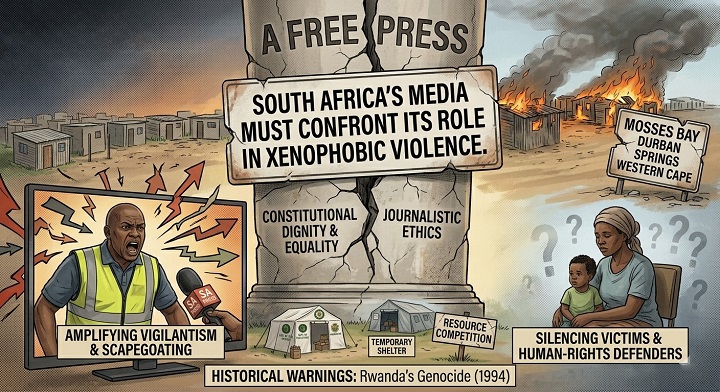
South Africa’s democracy rests on the pillars of a free press and fearless journalism. Yet today, those pillars are being tested. Xenophobic violence continues to displace families, destroy livelihoods, and claim lives across our country, from Durban to Mossel Bay, Springs to the Western Cape. And while the Constitution guarantees dignity, equality, and protection for everyone within our borders, the stories of those most affected are too often silenced.
Instead of amplifying the voices of victims, humanitarian workers, and human-rights defenders, media platforms frequently give disproportionate airtime to vigilante leaders and anti-immigrant movements. This imbalance does more than distort public understanding; it risks normalising unlawful conduct and legitimising vigilantism. History has shown us the dangers of irresponsible amplification. Rwanda’s 1994 genocide remains a stark reminder of how unchecked narratives can fuel collective violence.
Neutrality in The Face of Injustice is Complicity
The press cannot afford neutrality in the face of injustice. It must ask hard questions of law enforcement: Why are preventive measures absent? Why do prosecutions fail? Why are displaced families left unprotected? Journalism that fails to demand accountability risks becoming complicit in the erosion of democracy.
The call to action is clear:
– Commit to balanced, evidence-based, victim-centred reporting.
– Investigate attacks, displacement, and fatalities with rigour.
– Establish editorial safeguards against inflammatory rhetoric.
– Collaborate with civil society to document and track incidents of xenophobic violence.
– Provide context rooted in constitutional and international human-rights obligations.
A manufactured crisis: Who really benefits from South Africa’s anti-foreigner frenzy?
The Challenges Are Real, but the Media Needs to Do Better
South Africa’s challenges with migration, unemployment, and crime are real, but scapegoating immigrants through violence and misinformation is not a solution; it is a betrayal of our democratic values. The media must choose whether it will stand as a guardian of truth and justice, or as a silent witness to abuse.
Future generations will judge our institutions not only by what they reported on xenophobia, but by what they failed to report on. The time for corrective action is now.
Fediverse Reactions
Post URL
Your Profile
Why do I need to enter my profile?
This site is part of the ⁂ open social web, a network of interconnected social platforms (like Mastodon, Pixelfed, Friendica, and others). Unlike centralized social media, your account lives on a platform of your choice, and you can interact with people across different platforms.
By entering your profile, we can send you to your account where you can complete this action.


