

 Charles Ash
Durban, that bronze-medal seaside city on the east coast of South Africa. Famous for being the largest city in the kingdom of the Zulus; famous for its year-round balmy weather; famous for sharks; …and famous for having the largest Indian population outside of mainland India. In the 1800’s, Indians were transported from mainland India to South Africa, to work on the sugar cane plantations here.
It did’nt take long for these Indians to make their presence felt in Durban, where they soon infused their own culture into the fabric of everyday South Africa. Moreover, some bright spark (God bless his soul) invented what has become that quintessential icon of Durban cuisine, the famed bunny chow and pretty soon, Indian food became the staple diet of almost all the city of Durban’s inhabitants. Driving through Durban today, it is easy to see how the Indian community has made an indelible mark on the city and the region. This is evident when one looks at Lotus FM (the largest radio station aimed solely at Indians); the weekly newspaper The Post (aimed solely at Indians); The Sunday weekly supplement, the Tribune Herald (another newspaper publication aimed solely at Indians) and you soon get an idea of what a huge footprint the Indian community has left on the region.
You’re probably wondering why I’ve singled out the Indian community in my observations, when Zulus in South Africa have pretty much the same media leverage as Indian people do. The reason for this is that the Coloured and the Indian community have very much in common…in my humble opinion at least. At the turn of the last century (early 1900’s), both communities were afflicted with a massive identity crisis. I can just imagine what the dilemma was for leaders of South Africa’s fledgling Indian community. Being placed in a foreign land, against your will; having children born in this foreign land; trying to retain as much of your culture as possible; no doubt asking questions such as “we’re no longer in India, are we now African? still Indian? Afro-Indian? African-Indian?” while at the same time trying to assimilate and make the best of a bad situation. Certainly you can draw some parallels between the plight faced by South Africa’s Indian community and the African slaves taken to America to work on the cotton plantations there.
While this was what the Indian community faced, the Coloured community was being created in record numbers. In this hostile, race-centric world, straddling both sides of the racial divide was not the best position to be in (100 years later and still not much has changed). Then with the advent of apartheid and the social engineering feats required to sustain this system, each group was relegated to their demarcated corner of the world to live in imposed homogenous harmony.
We’re now 11 years into our new democracy and the one group that seems to have used the evil system of apartheid against itself with greatest effect is by far, the Indian community of Durban. Using the energy and force of another against itself is an old eastern philosophy, with the fruits of its practical application evident in the success ratio of Indians living in South Africa. Indians in South Africa went about creating their own trading districts (the Indian market and Grey street); setting up Indian civic groups; setting up Indian radio stations and newspapers and now lately, a TV show dedicated to celebrating Indian culture.
Having said all of this, is it not time that the Coloured community learns from the successes of the Indian community and foster the same sense of communal self-sufficiency? Media channels; newspapers; radio stations; is the Coloured community unable or unwilling to operate these mediums? I fear our beggar bowl mentality of waiting for handouts will be our undoing, and the single factor which will determine our community’s success ratio. The sooner we realize that we need media channels in order to promote our interests and our visibility in South African society; the sooner we realize that we can never influence the game while simply spectating; the sooner we realize that South Africa is our country too, then only will our community start to make progress and heal itself from years of self-inflicted grievous injury.
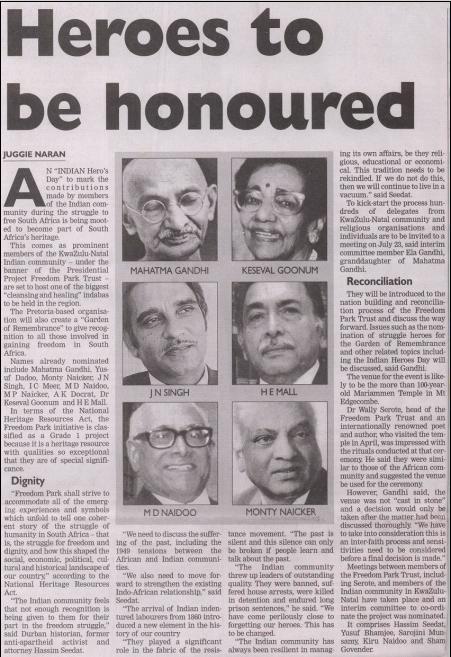
I read an article in the Sunday Tribune Herald on 26 June and it outlined a lobby for the recognition of Indian anti-apartheid icons and activists. To quote the first line from the article, “An “Indian Hero’s Day” to mark the contributions made by members of the Indian community during the struggle to free South Africa is being mooted to become part of South Africa’s heritage.”
Can the Coloured community lobby for something similar, like a “Coloured Hero’s Day”? Are there any Coloured heroes worth remembering and commemorating? Or are we so filled with self-loathing that we feel our Colouredness is something to be ashamed of and never celebrated? The answer to these questions will determine the rate at which our community is able to pull itself together and the rate at which we are able to make positive and much needed change.
Fediverse Reactions
Post URL
Paste the post URL into the search field of your favorite open social app or platform.
Your Profile
Or, if you know your own profile, we can start things that way!
Why do I need to enter my profile?
This site is part of the ⁂ open social web, a network of interconnected social platforms (like Mastodon, Pixelfed, Friendica, and others). Unlike centralized social media, your account lives on a platform of your choice, and you can interact with people across different platforms.
By entering your profile, we can send you to your account where you can complete this action.