

 Grant Pascoe
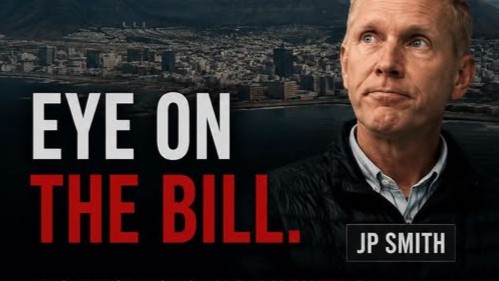
Few politicians in Cape Town have had more influence over a single portfolio than JP Smith has had over Safety and Security. For almost twenty years he has been the public face of the City’s crime-fighting strategy. He has championed bigger budgets, defended spending decisions and promoted a growing list of technology-driven initiatives as part of the answer to crime.
Today the Safety and Security budget stands at about R6.7 billion. That is not a small amount of money. It is one of the largest municipal safety budgets in the country. Year after year, JP Smith has argued for more resources, more technology and more investment. If there is one politician who can claim ownership of the City’s safety strategy, it is him.
That is why he cannot now distance himself from questions about the results.
Hard work does not equal return on investment
The issue is not whether JP Smith works hard. The issue is not whether some projects have delivered value. The issue is whether Cape Town residents have received the return they were promised after years of increasing expenditure and increasingly sophisticated interventions.
Over the years, residents have seen the rollout of more CCTV cameras, drones, gunshot detection technology, surveillance systems, specialised enforcement units and most recently the Eye in the Sky project. Every initiative was presented as an important tool in the fight against crime. Every initiative came with promises of improved safety and stronger law enforcement.
Yet many residents are asking a simple question. If this strategy is working, why do so many communities still feel unsafe?
JP Smith must account for Eye in the Sky failure
The Eye in the Sky project highlights the problem. It was promoted as a major crime-fighting innovation and carried a contract value of up to R125.9 million. Yet basic questions remain unanswered. How much was actually spent? How many hours did the aircraft fly? What measurable results were achieved? Why was the service ultimately discontinued?
These are questions that should have been answered long ago. When a politician publicly champions a project, takes credit for its launch and uses it as proof of progress, that politician must also account for its performance.

JP Smith cannot take ownership of the successes and walk away from the failures, shortcomings or unanswered questions.
Massive spending must result in measurable outcomes
The same principle applies to the broader safety budget. A budget of R6.7 billion should produce more than press releases, social media posts and technology demonstrations. It should produce measurable outcomes that residents can see and experience in their daily lives. People want to know whether shootings are decreasing, whether gangs are losing their grip on communities and whether public spaces are becoming safer.
The City’s response is often that crime is mainly the responsibility of SAPS. That is true. But that argument raises an important question. If the City does not have primary responsibility for crime prevention, why has JP Smith consistently argued for larger and larger municipal safety budgets? If the City wants recognition for investing in safety, then it must also be prepared to explain what those investments have achieved.
The real concern is that Cape Town’s safety strategy has become too focused on spending and too little focused on accountability. Residents are regularly told how much money is being invested. They are shown the latest technology and the latest projects. What they are seldom shown is a clear and independent assessment of whether these interventions are delivering value for money.
JP Smith needs to be judged by his results
After almost two decades, JP Smith should not be judged by promises, plans or announcements. He should be judged by results. The budget has grown. The technology has expanded. The question that remains is whether public safety has improved enough to justify the investment.
Cape Town residents have paid for this strategy. They have a right to know whether it is working. More importantly, they have a right to expect answers from the politician who has been its chief advocate for nearly twenty years.
Fediverse Reactions
Post URL
Your Profile
Why do I need to enter my profile?
This site is part of the ⁂ open social web, a network of interconnected social platforms (like Mastodon, Pixelfed, Friendica, and others). Unlike centralized social media, your account lives on a platform of your choice, and you can interact with people across different platforms.
By entering your profile, we can send you to your account where you can complete this action.


