


 Graeme Addison
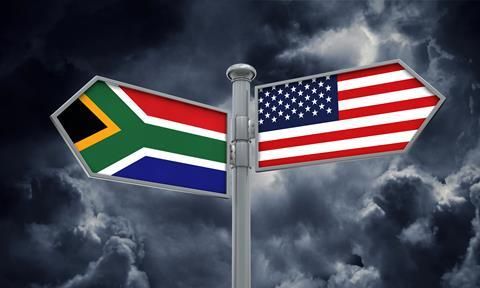
South Africans are watching events in the US — and now Britain — with a mix of shock, recognition, and even a little dark amusement. America, in particular, is an object lesson in what happens when the political climate threatens to tip into catastrophe.
There is no quick and easy way to measure the political weather and predict a storm. Social dynamics are too complex, too tangled, and too reflexive. One development feeds back into another, setting off ripples across multiple variables. What looks like a cooling breeze today may become tomorrow’s lightning strike.
We are doppelgangers in history. South Africans, black and white, have always seen a mirror in America. The parallels are uncanny:
– Civil war there, Anglo-Boer war here.
– Segregation and Jim Crow there, apartheid here.
– Assassinations and radicalism on all sides.
– A broad middle that prefers peace, stability, and prosperity.
– Land theft and cries for repossession.
– Slavery, freedom and resistance to change
Shared Ideologies and Historical Echoes
For black South Africans, especially, the US has long been a source of inspiration and ideology, from Martin Luther King to Black Consciousness. The mirrors stretch endlessly across our histories.
So when America begins sliding toward authoritarianism, many South Africans feel a sense of déjà vu. Been there, done that. And we know where it leads: decades, even centuries, of oppression for the many, while a privileged few live comfortably and get rich.
Today, both countries face the same spectacle of wealth concentration at the top and disillusionment at the bottom. The difference is that America has surged ahead economically — turbo-charged by digital giants and global dominance — while South Africa has slipped further down the global growth tables.
In the US, the danger is deepening division; in South Africa, it is mounting confusion. The dream of a hard-won democracy “to deliver a better life for all” has soured into the reality of patronage, corruption, and insiders thriving while millions remain trapped in poverty.
The Roots of White Supremacy
The similarities between South Africa and America are striking. They can’t be carried too far, but in one major respect, there is a consistent and overlapping pattern of power rooted in white supremacy.
I was challenged to show that the Anglo-Boer War and the American Civil War had anything much in common. Well, yes, a lot.
Both began as struggles over sovereignty. In South Africa, the Transvaal Republic refused to give the Uitlanders on the Rand any meaningful political power. When Cecil John Rhodes tried and failed to topple Kruger’s government through the Jameson Raid, Britain took up the matter directly, raising the issue of Boer independence but with its eye firmly on the goldfields. The Boer republics struck first, laying siege to Ladysmith, Mafeking and Kimberley.
This was not unlike the American South, which banded together as the Confederacy and opened the war by attacking Fort Sumter. The Southern States would not accept federal authority over slavery, which was the foundation of their economy and way of life. They believed Washington had no right to dictate local laws, resented tariffs that seemed to favour the industrial North, and felt their agrarian culture and honour were under threat. The election of Abraham Lincoln, without a single Southern vote, confirmed their fear of marginalisation.
The Boers, though less wealthy, shared the same defensive outlook. They felt that their independence, language, and pastoral way of life were under siege by a powerful industrial empire. Both the South and the Boers saw themselves as fighting for freedom, though in each case it was the freedom to preserve systems of privilege and exclusion.
And in both wars, the weaker side struck pre-emptively, not from confidence of victory but from the conviction that it was better to fight than to be swallowed whole.
There is more…
After the Boers lost the war, at the cost of appalling suffering under Lord Kitchener’s scorched-earth policy and the concentration camps where some 28,000 Boer women and children and more than 20,000 Black farm workers died, Britain moved to reconstruction. Farms lay in ruins, herds were slaughtered, and families were shattered. In the peace that followed, Britain imposed its own language, culture, and imperial institutions on the defeated republics.
The Rand gold mines, badly disrupted during the fighting, were soon revived, and industrial capitalism rose to full dominance over the political economy of the former republics. Yet the Boers did not remain a defeated people for long: within a decade, they regained political control through the Union of South Africa (1910), a self-governing dominion within the Empire.
This compromise allowed white unity, but it also entrenched the exclusion of the Black majority. The colour bar, pass laws, and racially discriminatory labour practices became embedded in both law and custom.
Reconstruction, Segregation, and Apartheid
In the American South, a strikingly similar cycle unfolded. After the Confederacy’s defeat, the period of Reconstruction brought federal troops, “carpetbaggers,” and new constitutions that briefly extended political rights to freedmen. But this interlude of emancipation was short-lived.
By the late 1870s, federal resolve had waned, and the “Redeemer” governments of the old Southern elite clawed back power. Jim Crow laws, poll taxes, literacy tests, and lynch terror reduced Black citizenship to a hollow promise. For nearly a century, African Americans in the South lived under systematic segregation and oppression until the Civil Rights Movement finally secured legal equality in the 1960s.
In South Africa, the trajectory was even more stark. White Afrikaner nationalists consolidated power through the National Party, and from 1948, formally codified apartheid, a system of rigid racial separation and disenfranchisement. It was only in 1994, after decades of resistance and international isolation, that apartheid was dismantled and a democratic South Africa founded on a liberal constitution was born.
And yet, despite these victories, the echoes of white supremacy remain strong in both societies. In the United States, nativism, racial resentment, and nostalgia for the antebellum South persist, feeding into modern populist movements. In South Africa, the memory of Boer victimisation and the belief in Afrikaner exceptionalism still resonate within certain communities.
Trump and the Politics of Grievance
The parallels are underscored by the fact that President Donald Trump, himself a champion of white grievance politics, has at times spoken of the Afrikaners as kindred spirits — a people who, like his own base, see themselves as persecuted heirs to a past when whites alone enjoyed the right to rule and shape the economy.
In both countries, the long shadow of these wars is visible in the deep racialised inequalities that persist. In the United States, the legacy of slavery and segregation is reflected in wealth gaps, mass incarceration, and voter suppression battles that disproportionately affect African Americans. In South Africa, apartheid’s end brought democracy but left land ownership, capital, and opportunity heavily skewed toward the white minority.
In each case, the triumph of formal equality has not erased structural disparities. The grievances of the past continue to shape politics today, giving fertile ground for populist appeals to race, identity, and victimhood.
And yet those who continue to enjoy privileges and power as their historical legacy now regard themselves as victims. They feel that The Other has invaded their space and stripped them of the respect they were wont to enjoy. In the US, the most calamitous confirmation of their fears came in the 2016 elections when Hilary Clinton tagged the supporters of Donald Trump as “a basket of deplorables”.
Populism and Blame in Two Nations
In South Africa, Nelson Mandela’s attempt to bridge the gap between the apartheid herrenvolk and the liberation movement saw him visit the widow of Dr Hendrik Verwoerd (usually regarded as the architect of apartheid). The gesture was noble and conciliatory, but over the decades since it has been overlooked by angry adherents on each side who cherish the wrongs of the past.
It is no surprise that frustration breeds populist solutions, or illusions. Scholars describe populism as a “thin ideology” that frames society as a pure people betrayed by corrupt elites. Populists thrive on blame games and scapegoating — targeting whoever can be cast as the obstacle to “real” democracy: immigrants, minorities, the opposition, or even independent judges.
In South Africa, this narrative is alive and well: elites blame “white privilege” on one hand and “ANC corruption” on the other. In the US, right-wing populists often accuse liberals, leftists, and “globalists” of treachery. In both cases, the structure is the same: explain failure by pointing to enemies.
Political theorists like Carl Schmitt long ago warned that authoritarianism feeds on constructing an “enemy within,” justifying exceptional powers. More recent comparative studies of democratic backsliding. Steven Levitsky and Daniel Ziblatt’s How Democracies Die shows how populist leaders weaken institutions bit by bit under the cover of defending the people.
Where to From Here?
The risks are palpable. Will South Africa see a military coup? Will a tribalist strongman emerge to seize control under the banner of “rescue”? No one can say with certainty. What we do know is that the drivers of anger are strong:
– Liberation ideals betrayed by self-enrichment.
– Violence and fear woven into daily life.
– Bloated government that is expensive yet ineffective.
– Hypocrisy and greed at every level of leadership.
The American example, with its right-wing conspiracies blaming liberals and the left, is reflected in South Africa’s own blame games: whites accused of clinging to privilege, the ANC accused of structural corruption disguised as democracy. Political scientists remind us that democracies rarely collapse overnight; instead, they erode through polarisation, loss of trust, and the normalisation of emergency measures.
ALSO READ: Why Neutrality is Not Virtue in the Face of Trump Tyranny
We Are on the Edge of Our Seats
Where it all ends, no one can predict. But South Africans, with our history of pulling back from the brink, watch the American drama with horror, recognition, and a certain gallows humour. Their crisis feels like a distorted echo of our own.
The heat is rising in both nations. There is no thermometer to tell us when it will boil over. But the smell of smoke is unmistakable. The world is watching the US, while South Africa has fallen off the news agenda, except for its own people. Only Trump’s pro-Afrikaner rhetoric has revived some interest in this country.
Yet those who live here can feel the fever coming on.