


 Ryan Swano
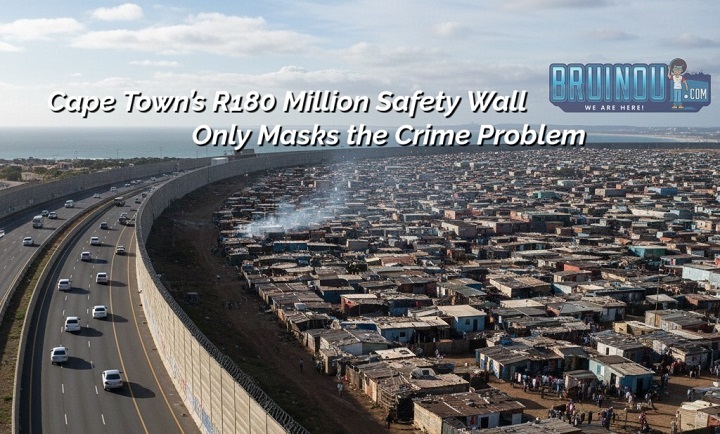
Once again, Cape Town finds itself responding to a senseless tragedy with an expensive physical structure rather than confronting the deeper social and policing failures that made that tragedy possible. Last week the City of Cape Town confirmed that it will press ahead with plans to build a R180 million “security wall” along sections of the N2 near the airport following yet another violent attack on motorists on one of the city’s most dangerous roads.
The City argues that the wall will create a physical barrier to deter criminals who target vehicles, throw stones or launch smash and grab attacks on unsuspecting drivers. Officials have said it could reduce disruptions and improve commuter safety by making it harder for attackers to reach vehicles from the roadside and provide controlled access points with reinforced fencing and surveillance infrastructure.
The City’s Case for The Wall
On paper these benefits sound compelling. Motorists have long complained about attacks near the airport and along the N2, including incidents where large objects are used to force cars to stop or criminals approach vehicles waiting at lights or intersections. Police and City officials have also bolstered safety patrols on the route and deployed additional metro police officers in an effort to make these stretches safer.
But the announcement has ignited fierce criticism from residents, commentators and urban planners who see this wall as a superficial fix that will do little to address the root causes of crime in Cape Town. On social media voices like Tarryn-Lee Bell and Darren Campher have pointed out that spending hundreds of millions on a barrier reinforces the city’s persistent spatial divides rooted in apartheid planning by effectively sealing off spaces rather than genuinely making them safer.
In her post addressing the City of Cape Town’s plan for the R180 million wall, Tarryn-Lee Bell argues that the R180 million rand could, and should be better spent.
“R180 million for crime, yet at the Nyanga/Gugulethu turn-off we hardly see a permanent law enforcement presence. No consistent visibility. No sustained protection.”
“If the City is serious about crime prevention, R180 million is not small money, there are immediate, practical interventions that could deliver real short-term safety outcomes without deepening spatial division.”
One also has to wonder who this idea will benefit financially, since a R180 million contract to build a ‘safety wall’ seems like quite a lucrative prospect. How did the City of Cape Town come up with a cost estimate of R180 million? Do they already have an existing bid from a preferred contractor? Will the tender requirements be made to fit an already existing bid, so that it becomes a rubber-stamp process?
WATCH: Darren Campher Criticises Cape Town’s R180 Million Safety Wall
Reinforcing Old Spatial Divides
Those critiques touch on a deeper truth about Cape Town’s struggle with crime. The violence that affects motorists travelling on the N2 is not an isolated quirk of geography. It is a symptom of a city where inequality remains entrenched and where policing, social services, education and economic opportunity are patchy at best. Physical barriers cannot resolve the despair and exclusion felt in many communities that lie adjacent to these high-risk roads.
There is also a troubling symbolic message in choosing to build walls rather than build civic trust and capability. The wall project draws criticism because it looks like punishment of space rather than people. It encloses the problem instead of confronting it. It is a response that says we will make better barriers not better neighbourhoods. For many observers this approach is not just short sighted but regressive.
The proposed wall is also being compared to the Donald Trump Border Wall between the USA and Mexico as well as the Israeli Apartheid Wall, aka the West Bank Barrier, that seals off parts of Palestine.
Is There a Racial Disparity in the City’s Response?
There are also criticisms raised by the fact that the plan for Cape Town’s R180 Million Safety Wall was announced shortly after the fatal attack on a white woman visiting Cape Town from another province. Those criticisms are not simply a kneejerk reaction to racialise the issue, since any death from crime in our city is one death too many.
I’m not saying that it is or isn’t the case, but the criticism itself cannot be ignored.
Those who raise the issue are saying that these crimes happen daily on the Cape Flats, but now that there is high profile story of a white victim from outside the province, suddenly R180 million is available to build a wall.
The response to similar crimes against mostly Coloured and Black, but often also white Capetonians who deal with the same threat daily on major thoroughfares like 35th Street in Elsies River, or Jakes Gerwel Drive in Langa and Bonteheuwel have seen scant improvements in police and law enforcement presence and visibility. Those hotspots are where crime on motorists happen daily and are arguably far more common than on the N2.
The Illusion of Security
This is not to say that nothing should be done. Cape Town has already invested heavily in safety measures across the city and is spending millions on policing infrastructure, technology and community safety initiatives. But this wall feels like a bandage at a time when a more holistic and long term strategy is needed. If the City genuinely wants to reduce the scourge of violent crime it must go beyond barriers, fences and patrols.
True safety requires investment in communities that have been marginalised for generations. It requires functioning schools, jobs programmes, responsive and well-resourced policing, and real partnerships with the residents who know the terrain far better than any engineering plan can capture. Spending R180 million on a wall that treats symptoms is not the same as spending that money on interventions that could prevent crime from happening in the first place.
What Real Safety Actually Requires
Cape Town deserves better than box ticking solutions and symbolic infrastructure. It deserves a strategy that acknowledges why crime persists and tackles those causes with the same urgency that we now show in planning physical defences. A wall might make some motorists feel safer for a short time, but it does nothing to dismantle the spatial and social divisions that make parts of our city so vulnerable to crime. We should be addressing those first.