


 Jason Patrick Hanslo
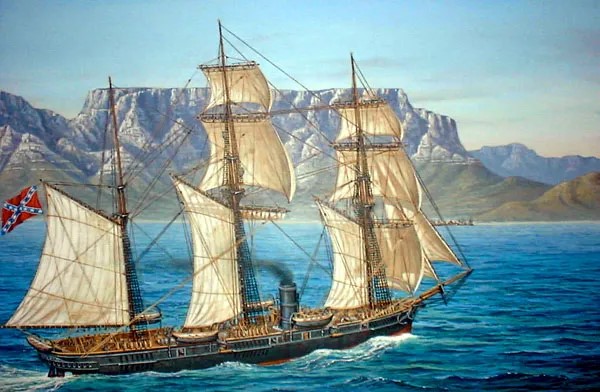
The CSS Alabama, a Confederate warship, anchored in Table Bay, Cape Town, in 1863, capturing the American bark Sea Bride. This event is documented in historical records, including a newspaper clipping from 1863 with the title “Naval Battle in Table Bay; Alabama captures the Seabride”.
The ship’s visit to Cape Town is also referenced in the kaaps folk song “Daar kom die Alabama”, suggesting a possible connection between the ship and the song. The song’s origins and inspiration are unclear, but it’s plausible that the Minstrels’ song “Daar Kom die Alabama” is linked to the CSS Alabama, given the ship’s presence in Cape Town in 1863.
[The song is more often referred to, sung, spelt and pronounced as ‘Daar Kom Die Alibama’. – Ed]
Minstrels, Timelines and Disputed Origins
The history of the Minstrels, also known as the Kaapse Klopse, is also tied to Christy’s Minstrels, who performed in the Cape Colony in 1864, just a year after the Alabama’s visit. This timeline supports the argument that the Minstrels’ song could have been inspired by the ship.
While Peter Ross, a writer for Cape Odyssey, disputes this connection, the evidence suggests a strong possibility that the CSS Alabama is the inspiration behind the song.
In order to further this line of thought I asked myself; What are the exact lyrics of “Daar kom die Alibama”
A quick newspaper search found the exact lyrics: the Cape Standard Newspaper 27 July 1936 published the lyrics as well as some history;
The song “Daar Kom Alabama”(note the spelling; Peter Ross’ lyrics in his article is different “Alibama” and he uses this spelling to suggest another vessel.
Daar kom die Alibama, die Alibama die kom oor die see.
Nooi, nooi die riet-kooi nooi
Die riet-kooi is gemaak
Die riet-kooi is vir my gemaak
Om daarop te slap
O Alibama, O Alibama die Alibama die kom oor die see.
Unlike Peter Ross I looked at the arrival of the ship in context of the times. You see the Alabama’s arrival coincides with Christy’ Minstrels; a coon carnival group from the US that also happens to be from the deep South of America. As well as the fact that the Alabama arrives more or less at the time Christy’s Minstrels perform in the Cape Colony… a more holistic approach towards the origin of the song is needed.
The melody is catchy and rhythmic, originating from a plantation song in America, specifically from the famous Bahama range.
Dance Floors, Adaptation and Rhythm
According to Umteteli wa Bantu newspaper 13 May, 1923 the words were adapted by local dance musicians in Cape Town, who fitted them to the Lancers dance. Over time, it became customary for dancers to sing the words while performing the dance.
The lyrics, “Daar kom Alabama”, have been passed down, and the song’s history dates back to over 40 years prior to 1936, suggesting it was popularized in the late 19th century. The article puts the origin of the song at 1894. Which corresponds with the dancing style of the time.
The song’s compelling rhythm made it a hit, and it was often sung during the fourth figure of the Lancers dance. The musicians would adapt the melody, making it a unique blend of international influences.
The Lancers dance is a type of quadrille, a traditional ballroom dance that originated in Europe in the 18th century. It was popularized in the 19th century and involves a set of four couples arranged in a square or rectangular formation.
In the context of “Daar Kom Alabama”, the song was likely adapted to fit the rhythm and tempo of the Lancers dance, making it a fun and catchy tune for dancers to enjoy.
WATCH: The Pennsylvanians Minstrel Club perform Daar Kom Die Alibama
Lyrics, Sailors and Dockside Realities
When we look deeper into the actual words used we find a more plausible story than the one Peter Ross aims to paint.
I once read a story about the American Gen 2(Generation 2) ship who also laid anchor like other passing ships and long story short the word “jintoe” (derogatory word for prostitute), came into being…. during the beginning of the late Victorian era in Cape Town, prostitution was considered an offense but was rarely prosecuted. The majority of prostitutes during this time were local women of color, though there was a small number of European women partaking in sex work as well.
On page 673 of History Compass written by Henry Trotter in 2008 he explains that Dockside prostitutes were women who dealt almost exclusively with foreign sailors that stopped at Cape Town’s ports. These prostitutes frequented taverns, clubs, and other areas where sailors sought recreation together, and engaged in both sexual and social acts of service to their clients (e.g. talking, drinking, and dancing). Furthermore, due to the international and social nature of their clientele, dockside prostitutes in Cape Town were typically proficient in multiple languages.
The lyrics “rietkooi” (reed bed) could indeed be linked to the sailors’ stay and the notorious history of the slave lodge as a brothel. Suggesting the sailors’ exploits and the prostitutes’ involvement in the festivities. The chorus listing the months might relate to the Alabama’s multiple visits to Table Bay, adding weight to the connection between the ship and the song.
The mention of “Daar onder in die Kaap” implies the song’s narrator was likely on Signal Hill, spotting the ship and sending messages to friends and prostitutes.
Given the evidence, it’s plausible that the Minstrels’ song “Daar Kom Alabama” is indeed inspired by the CSS Alabama‘s visits to Cape Town. The song’s themes and lyrics seem to match the historical context, making a strong case for the connection.
[This is my own interpretation, my own research, and my own perspective. This is not FACT and although compelling should assist other researchers in their quest to revealing the truth about the origin of the song – Jason Patrick Hanslo]